
It may not be super obvious (because the conquest doesn’t start until Joshua), but the Israelites are right there. Canaan isn’t that far away; in fact, they have a direct line until Edom steps in and forbids them from crossing over their territory. This obstruction makes the people angry and they begin to grow “impatient because of the journey.”
Because of this, they lash out against God and Moses claiming (contradictorily) that there’s no food and that they hate manna. They argue that there’s no water either, even though God has literally brought it forth from at least two rocks (Massah/Meribah and Meribah), which probably means He’s providentially provided it other times as well.
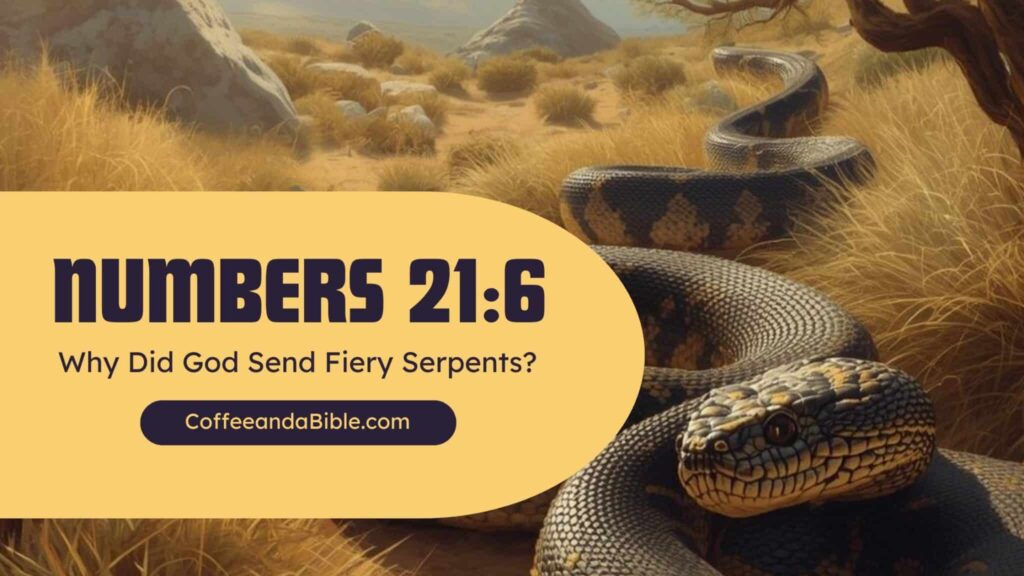
This will officially be the last time that the children of Israel complain in the wilderness, but the reaction from God is arguably the most severe. He sends “fiery serpents” among the people in order to punish them. Many die, until Moses sets up a bronze serpent on a staff for them to look at.
Why serpents though? And why do the serpents have to be fiery?
For the longest time, I assumed that the “fiery” here meant literally “on fire.” Then, I turned 12 and realized that would be a completely different punishment altogether.
The “fiery” aspect of these snakes owes to their bite or their venom (or both). Anyone who’s ever been bitten knows the burning sensation that accompanies it. If whatever bit you was venomous, the excruciating pain as the poison goes through your body also feels equally unpleasant. In extreme cases, you can feel like you’re burning from the inside out.
These types of snakes are actually common to this part of the world. The Transjordan area, specifically around the part around Mount Hor, is home to all sorts of venomous snakes. In the present day, at least 37 different species of cobras, vipers, and other things that will kill-you-while-they-crawl are found in this exact location (Deuteronomy 8:15).
One could argue that this means God sending the snakes wasn’t a miracle as much as it was letting nature take its course. But even if you do take that stance, you have to acknowledge that the sheer scale of venomous snakes in the area necessitates a miracle already.
Consider this: If this area is known as being such a dangerous place to live (because of the wildlife), then how is it that this many people lived there for so long without a problem? Why is it that after forty years, now they’re experiencing a problem with snakes?
Only one of two answers remains: Either God sent more (miracle), or He removed His protection from them (miracle). No matter which way you slice it, God’s hand is present.
It also creates a nice bookend with the plagues that God sent to Egypt. The frogs, lice, locusts, and other diseases that God sent mirrored the local ecology, as well as created a mockery of Egyptian gods.
Likewise, the “plague” of the fiery serpents are an intensification of what’s already there, with the goal of getting the people to look towards the one true God. The people’s request for Moses to intercede parallels what Pharaoh himself said to Moses on five different occasions (Exodus 8:8; 8:28; 9:27-28; 10:16-17; 12:32).
I guess they should be happy there weren’t nine more plagues immediately after?